How to Keep Your Dog Active — Safely — After TPLO Surgery
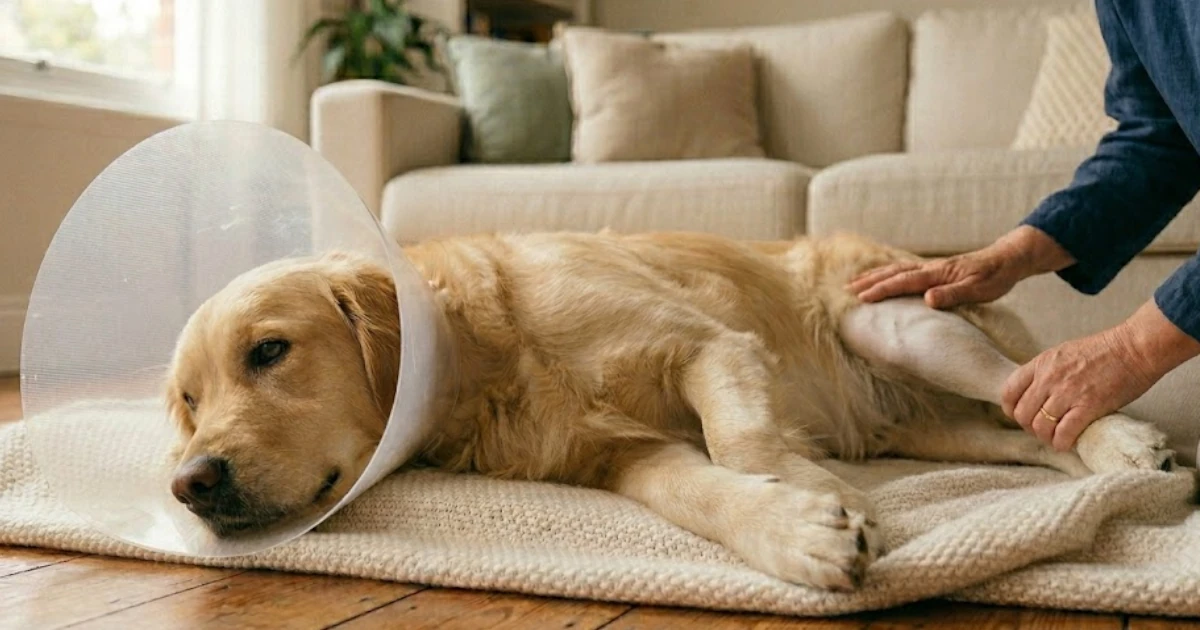
Your dog just had TPLO surgery. They’re on the couch with a shaved leg, a cone they despise, and those unmistakable “why did you betray me” eyes. Your vet’s instructions boil down to keep them still for three months, and your dog, who was tearing around the backyard 48 hours ago, has absolutely zero interest in cooperating.
Here’s the part nobody warns you about: the hardest thing about TPLO recovery isn’t the surgery itself. It’s the twelve weeks of managing a dog who feels progressively better while their bone is still knitting together. You’ll second-guess yourself constantly. Is that limp getting worse? Are they putting weight on it? Can I let them off the lead yet?
The good news is that total lockdown isn’t the answer. Controlled exercise after TPLO surgery actually speeds up recovery. The trick is knowing what “controlled” means at each stage.
The bone needs eight weeks. Your dog’s patience won’t last two.
TPLO (tibial plateau levelling osteotomy) has a strong track record. A review of outcomes published in Veterinary Medicine: Research and Reports found 93% owner satisfaction, and dogs who’d had the procedure achieved limb function that was basically indistinguishable from healthy dogs within a year. Those are good odds.
But (and this is the bit your dog won’t understand) all of that depends on what happens during recovery. The tibial bone takes a minimum of eight weeks to heal. One badly timed leap off the deck, one overzealous sprint after a magpie, and the whole repair can fail. Colorado State University’s veterinary orthopaedic team doesn’t mince words: premature or uncontrolled activity risks partial or complete failure of the surgical repair.
So why not just crate them for eight weeks and call it done?
Because muscles waste fast. The quadriceps and hamstrings that support your dog’s knee will weaken significantly without use, and a 2022 systematic review in Veterinary Surgery looking at 19 separate studies confirmed that dogs who received structured rehab had better range of motion, stronger weight-bearing, and got back on their feet sooner than dogs stuck on crate rest alone. Doing nothing isn’t just boring for your dog. It actually slows them down.
What you’re aiming for is the middle ground: enough movement to support healing, not so much that you risk the repair.
The first fortnight: less is genuinely more
Weeks one and two are not about fitness. They’re about pain management and preventing the joint from seizing up.
Take your dog out on a lead for toilet breaks. Five minutes, flat ground, slow pace, three or four times a day. That’s it. These aren’t walks in any meaningful sense. You’re just getting them outside, letting them do their business, and bringing them back in. If they try to pull or pick up speed, shorten the lead.
While they’re resting (which should be most of the time), you can do passive range-of-motion exercises. This sounds fancy, but it’s really just gently flexing and extending their knee in a slow cycling motion while they’re lying on their side. Ten slow reps, a couple of times a day. It keeps the joint from stiffening up without putting any load on the bone. If your dog tenses up or pulls away, ease off. They’re telling you something.
Ice packs wrapped in a towel, applied for 10–15 minutes after any movement, will help with swelling in those early days. And light massage above the knee (not on the incision) keeps blood flowing to the area.
A quick word on sanity, both yours and theirs. A dog who’s used to being active and is suddenly confined to one room will go a bit stir-crazy. Puzzle feeders, snuffle mats, frozen Kongs, and nose-work games are absolute lifesavers here. You’re essentially trying to tire out their brain since their body is off-limits. It works better than you’d expect.
Avoid stairs entirely (carry them or get a ramp), keep them off slippery floors (throw down some rugs on the tiles), and don’t leave them unsupervised in the yard. Dogs are terrible at following post-op instructions.
Weeks three and four: longer walks, same caution
By week three, you should see your dog starting to use the leg more. They’ll still favour it, and that’s normal, but you’ll notice them putting weight on it during walks and even shifting onto it when they stand up.
You can start stretching those lead walks out to eight or ten minutes, two to three times a day. Still flat ground, still a steady pace. No hills, no uneven terrain, no off-lead adventures. Even if your dog looks like they’re ready for more, they’re not. One unexpected lunge at a cat and you’re potentially back at square one.
Keep doing the passive range-of-motion work until their knee is moving close to its full range. And add sit-to-stand exercises: ask your dog to sit, then stand, then sit again. It’s a simple movement, but it engages the quadriceps and encourages them to load both hind legs evenly. Start with five reps and add a few more each week as they get stronger.
This is also the stage where you’ll be most tempted to let them do more than they should. They’ll look better. They’ll want to play. Resist.
Weeks five through eight: now it starts to feel like progress
Around week five, you’ll notice a shift. Your dog is moving more naturally, bearing weight more evenly, and probably getting increasingly unimpressed with the whole “controlled walks only” routine.
The good news is you can push things a bit further now. Lead walks can extend to 20–30 minutes, two or three times daily, and you can introduce gentle inclines and varied terrain. Short grass, packed dirt, that kind of thing. Nothing slippery or steep.
This is a good time to try figure-eight walking on the lead. Walk your dog in slow, wide figure-eight patterns. It’s not exciting, but it forces controlled weight-shifting and gentle turns that build the stabilising muscles around the knee. You can also progress the sit-to-stand exercises to 10–15 reps, and try having them stand on a slightly uneven surface (a folded towel on the floor works) to challenge their balance.
Gentle tug-of-war is fine as long as your dog stays planted and doesn’t launch into full zoomie mode.
The 6–8 week checkpoint is non-negotiable. Your vet will schedule follow-up X-rays to confirm the bone has healed. Do not escalate activity until those X-rays come back clear. I know it’s tempting. Wait anyway.
If your budget stretches to it, this is also the ideal window to start professional rehabilitation, whether that’s hydrotherapy or veterinary physio. More on that in a moment.
Weeks nine to twelve: the home stretch (almost)
X-rays are clear. The bone has healed. But “healed bone” and “fully recovered dog” are two different things. The muscles, ligaments, and joint confidence still need catching up.
Walks can now hit 30–40 minutes at a brisker pace. Hill walking is brilliant for building hindquarter strength, and you can start introducing controlled off-lead time in a secure, fenced area with no other dogs around. Watch them carefully. If they’re limping afterwards or reluctant to use the leg the next day, you’ve pushed too far.
Brisk lead walks and light jogging are on the table too, as long as you avoid sharp turns. Short games of fetch work well if you roll the ball along the ground rather than lobbing it in the air. You can also try brief, supervised play sessions with calm, known dogs. Not the dog park, though. Dog parks are chaos at the best of times, and a rambunctious stranger dog body-slamming your recovering one is the last thing you need.
Still hold off on high-impact jumping (off decks, in and out of cars, onto furniture) and anything involving sprinting or sudden direction changes. That comes later.
Beyond twelve weeks: the slow return to real life
Most dogs get the all-clear for unrestricted activity somewhere between 12 and 16 weeks, depending on how they’ve progressed. The word to tattoo on your brain is gradual. Bump up intensity by maybe 10–15% per week. Don’t go from controlled lead walks to a two-hour beach sprint on day one.
One thing worth flagging: some degree of arthritis will develop after cruciate ligament injuries regardless of how well surgery goes. That’s not a failure of the surgery. It’s just the nature of the injury. But dogs who’ve had TPLO tend to have less pain and better long-term mobility than dogs treated with other surgical techniques. Keeping their weight healthy, maintaining regular low-impact exercise, and talking to your vet about joint support will all help manage it.
Professional rehab: is it worth it?
Not every dog needs it, and the home exercises above will get most dogs through recovery in good shape. But the evidence for professional rehabilitation is genuinely impressive.
A 2023 case study published in Animals followed a dog that didn’t start rehab until six weeks after TPLO, with no prior physio at all. After just six sessions combining cold therapy, electrical nerve stimulation, and treadmill work, the dog’s weight-bearing asymmetry plummeted from 34% to 6%. Their pain score dropped from 24 out of 36 to just 2. Six sessions.
That’s not typical for every dog, but it shows what targeted rehabilitation can do, even when it starts late.
Your main options:
Underwater treadmill is probably the most popular. The water takes weight off the joint while still making the muscles work. Research into aquatic treadmill therapy for post-cruciate dogs found that having the water level at or above the stifle (knee) joint gave the best movement patterns for recovery. Two or three sessions a week, usually starting around weeks two to three.
Veterinary physiotherapy covers guided exercises, hands-on manual therapy, and modalities like therapeutic ultrasound or laser. It’s tailored to your dog’s specific progress.
Cold compression therapy actually had the strongest evidence base in the 2022 systematic review. Two well-designed studies showed it reduced pain and improved range of motion within 24 hours of treatment.
If your dog is a larger breed, works or competes, or is recovering slower than expected, professional rehab is worth a conversation with your vet.
When something doesn’t look right
Recovery wobbles. Some days your dog will stride around the block looking like nothing happened, and the next day they’ll limp to the water bowl. Ups and downs are normal, especially in the first month.
What’s not normal:
- A sudden return of heavy limping after they’d been improving
- Only touching their toes to the ground, or holding the leg up completely
- The area around the incision getting swollen, hot, or red
- Any discharge or smell coming from the wound
- Going off their food or becoming unusually flat
If you spot any of these, pull back on activity and call your vet. Catching things early, whether it’s an infection, an implant concern, or a soft tissue flare-up, makes a real difference.
What to remember
TPLO recovery is a patience game. Your dog will feel ready long before they actually are, and your job for three months is to be the boring, responsible one who says “not yet.”
But it does end. And if you stick to the timeline (short walks first, gradual progression, X-ray clearance before pushing further, and plenty of puzzle toys to keep everyone sane) most dogs come through it moving better than they have in months. Maybe years, if that cruciate had been dodgy for a while.
The zoomies will come back. Just not yet.