Why Cats Knock Things Off Tables: Feline Behaviour Decoded
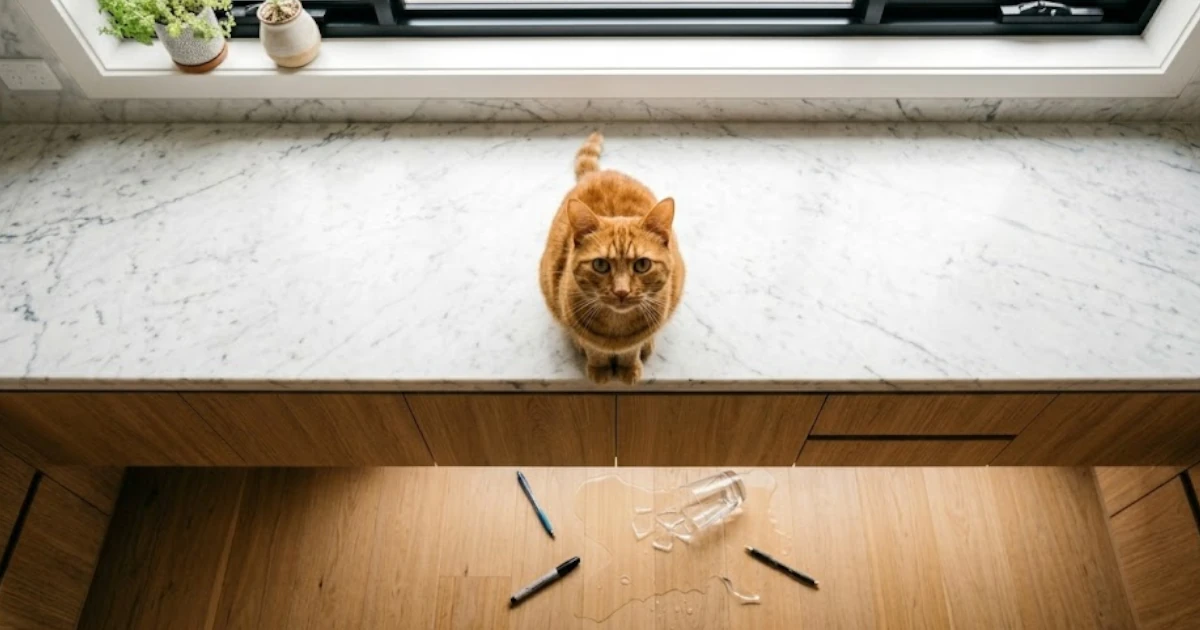
It’s 2am. You’re half-asleep. From the kitchen comes a sound you know too well: the slow scrape of ceramic on stone, followed by a pause (dramatic, deliberate), and then the crash. You stumble out to find your cat perched on the benchtop, staring at the shattered remains of your favourite mug with what can only be described as professional satisfaction.
It looks personal. It feels like revenge for that vet trip last Tuesday. But here’s the thing: your cat doesn’t have the cognitive architecture for spite. What they do have is a finely tuned predatory brain trapped in a lounge room with nothing to hunt. And that mug? It never stood a chance.
The hunting sequence that won’t switch off
Every domestic cat carries the same predatory motor sequence as their wild ancestors: stalk, bat, pounce, bite. What makes this interesting is that each stage can activate independently of the others, and independently of hunger. Your cat doesn’t need to be starving to swat a pen off your desk. The swatting itself is neurologically rewarding.
Ethologist Paul Leyhausen documented this decades ago: the motor patterns decouple. A cat can fire up the “bat” phase without ever intending to eat anything. So when your cat lines up a salt shaker and gives it a careful nudge, they’re not misbehaving. They’re executing a hardwired behaviour sequence that worked brilliantly for thousands of years in the wild, and happens to be deeply inconvenient on a kitchen bench in suburban Melbourne.
Your cat probably understands gravity
This is the part that stings a little. They might actually know what’s going to happen.
In 2016, researchers at Kyoto University ran an experiment with 30 cats. They shook containers (some with objects inside that rattled, some empty and silent) then tipped them over. Sometimes an object fell out as expected. Sometimes it didn’t, defying what the sound had suggested. The cats stared significantly longer at the physics-defying outcomes, the way you’d do a double-take if someone dropped a ball and it floated upward.
Lead researcher Saho Takagi concluded that cats use “a causal-logical understanding of noise or sounds to predict the appearance of invisible objects.” In plainer terms: your cat hears a rattle, expects something to fall, and notices when reality doesn’t match up. That’s a rudimentary grasp of gravity. Published in Animal Cognition, the study was the first to demonstrate this kind of causal reasoning in domestic cats.
So when they nudge your phone toward the edge of the table, there’s a reasonable chance they know exactly where it’s headed.
Those paws are doing more than you think
Cat paw pads are packed with specialised mechanoreceptors: Pacinian corpuscles that detect vibration, Merkel endings that register pressure, and Meissner-like corpuscles that pick up texture changes. When a cat bats an object, they’re not just pushing it. They’re reading it. Weight, texture, how it responds to force. All of it processed through a sensory system fine-tuned for evaluating whether something is alive, dead, or worth investigating further.
This also explains why they don’t just knock one thing and stop. Cats habituate fast. Research by Hall and Bradshaw found that three play sessions with the same toy caused near-complete habituation, but a novel toy immediately restored full play intensity. Your cat finishes with the pen, gets bored, and moves on to the remote. Then the coaster. Then whatever’s left.
The attention trap
Here’s where we make it worse. Your cat pushes a glass. You leap up, shout, rush over, make eye contact, maybe even pick them up to move them. From your cat’s perspective, that was an excellent outcome. Interaction. Attention. Drama.
Operant conditioning at its simplest: behaviour that produces a reaction gets repeated. And cats are sharp enough to learn this fast. A 2023 study of 1,591 cats found that when play was withheld, 22% of guardians reported increased attention-seeking behaviour. A bored cat who discovers that knocking things off surfaces reliably summons a human has zero reason to stop.
The fix is counterintuitive: ignore it. No eye contact, no scolding, no diving to catch the falling object. Remove the reward and the behaviour loses its payoff. (Easier said than done at 3am, obviously.)
What actually helps
You can’t train the predatory motor sequence out of a cat. It’s baked in. But you can redirect it.
Daily interactive play makes the biggest difference. Five to ten minutes with a wand toy, mimicking the stalk-chase-pounce sequence, gives your cat a legitimate outlet for the same impulse that drives the table-clearing. Schedule it around dawn and dusk, when cats are naturally most active.
Rotate toys every two to three days. That rapid habituation means yesterday’s feather toy is today’s furniture. Swap things out regularly and “old” toys feel new again.
Secure the breakables. This isn’t defeat. It’s acknowledging that you share a home with a small, gravity-aware predator. Museum putty on ornaments, water bottles instead of open glasses on benchtops. Work with the behaviour, not against it.
And if your cat is an indoor cat (as most Australian cats increasingly are), enrichment matters even more. Puzzle feeders, vertical space, window perches: anything that gives their brain something to investigate that isn’t your phone charging on the nightstand.
The bottom line
Your cat isn’t plotting against you. They’re a curious, sensory-driven predator with a working understanding of physics, and they’re stuck in a house full of objects that are begging to be investigated. The knocking is exploration, not vendetta. It’s science, just very inconvenient science.
Next time you hear that telltale scrape from the kitchen bench, remember: your cat isn’t being bad. They’re being a cat. A slightly too-clever-for-their-own-good, gravity-testing, paw-pad-reading, attention-learning cat.
Looking for a cat sitter who actually understands feline quirks? Lapdog’s vet nurses know the difference between a bored cat and a stressed one, and they’ll keep your benchtops (mostly) intact while you’re away.